

Subscribe to continue reading
Subscribe to get access to the rest of this post and other subscriber-only content.
Subscribe to get access to the rest of this post and other subscriber-only content.
My SoundCloud universe expands through participation in the Naviar Haiku Project, which prompts members to compose a piece based on the theme of a weekly provided Haiku. The group not only attracts composers and music enthusiasts, looking for creative inspiration, but also haiku enthusiasts. One enthusiast, Chèvrefeuille, introduced me to the site he hosts called:
The special feature titled “Use that quote“, offers the goal of writing haiku based on a famous quote, which runs in a similar vein to the goal of the Naviar Haiku Project. One particular quote of interest is by Leonardo Da Vinci:
“Why does the eye see a thing more clearly in dreams than the imagination when awake?”
So…here is my first attempt ever at Haiku:
I tied for 3rd Runner-up out of 285 entries. This was such a great experience!
I’ve been a member of SoundCloud for over two years, but I’ve never really gotten into groups. The first group I joined was a showcase group for a college composition class. The group allowed us to show off a little and get a feel for what everybody else was doing, but lacked in a real-time element because it was meant for posting the final project after-the-fact. My final project is still in the group and it gets a little attention every month as each new class comes through, but nobody wants to comment because they don’t really know me. When SoundCloud teamed with the Smithsonian, the experience changed my outlook on participating in groups. View full article »
I recently had a conversation with a friend in which I introduced him to the “out-of-speakers” trick as it was presented to me in Mixing Audio (Izhaki, 2012). I think, of all things I learned in my Music Production degree, this was the most surprising. Maybe this trick has been used on me before, but the manner in which the out-of-speakers trick is applied in the audio files accompanying the book jumps out at a person, or rather into a person. I’ve never heard such a stark example; I perceive the sound as inside my head or wrapping around.
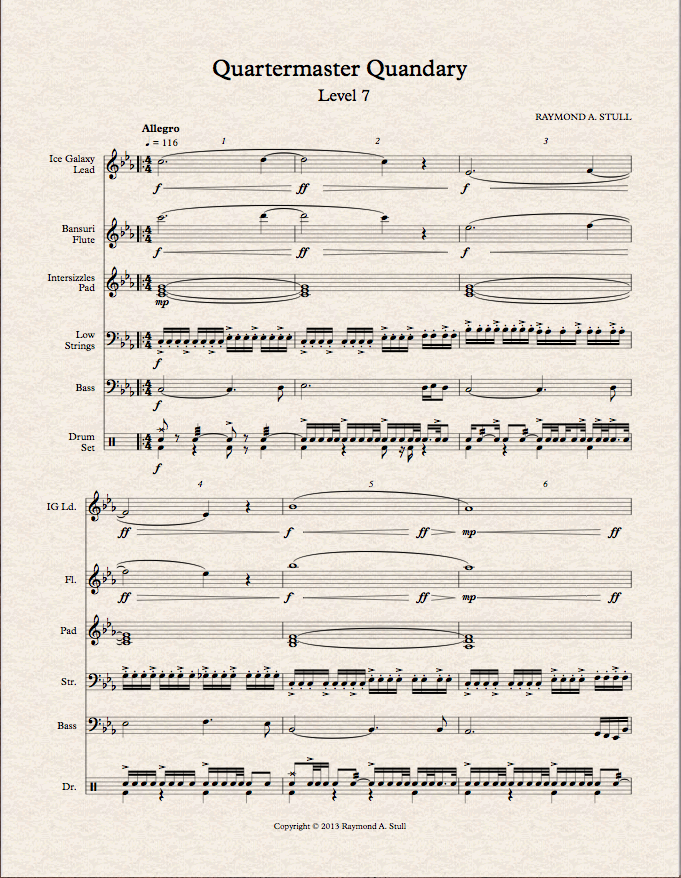
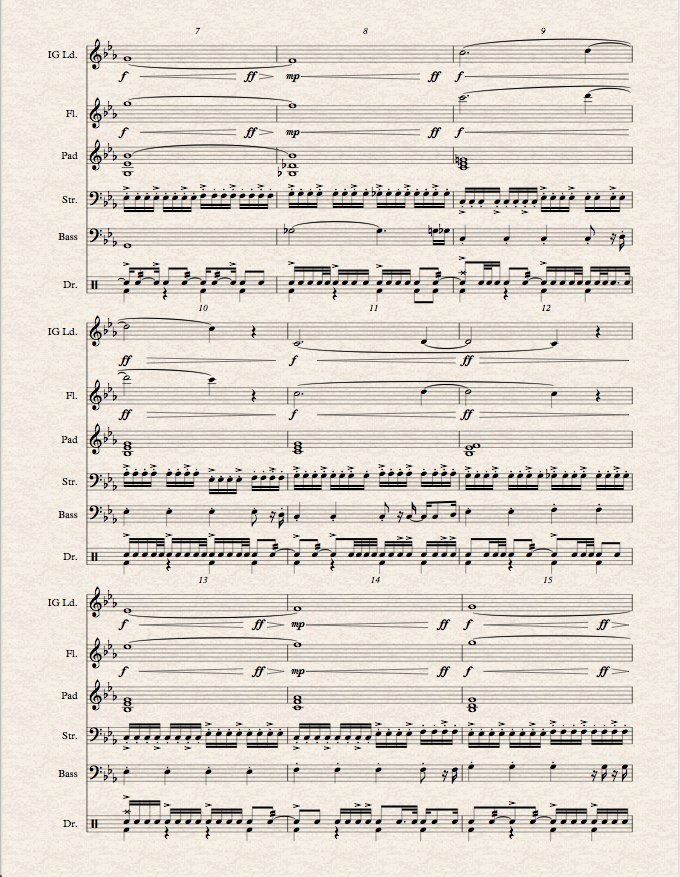
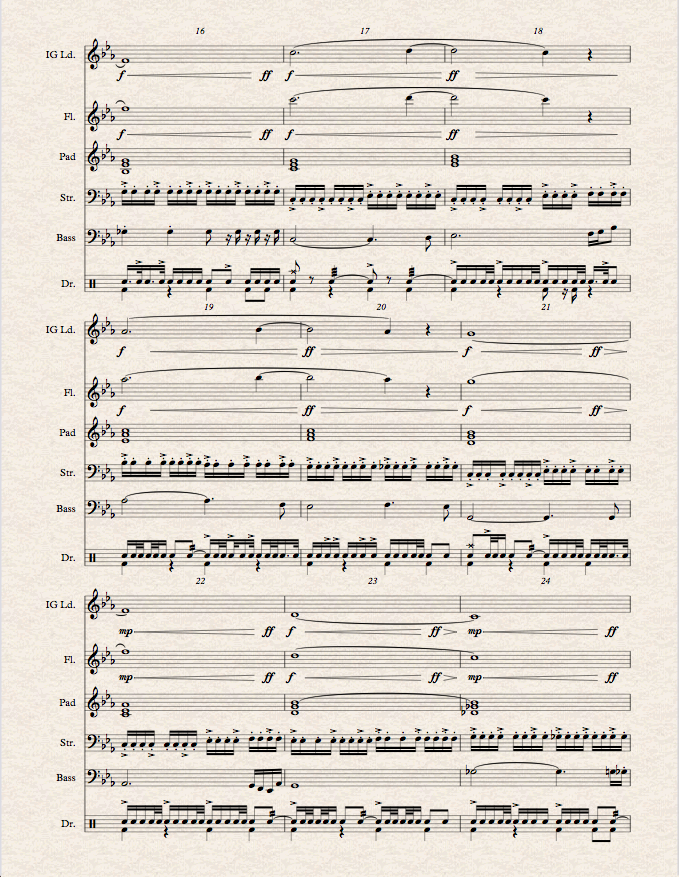
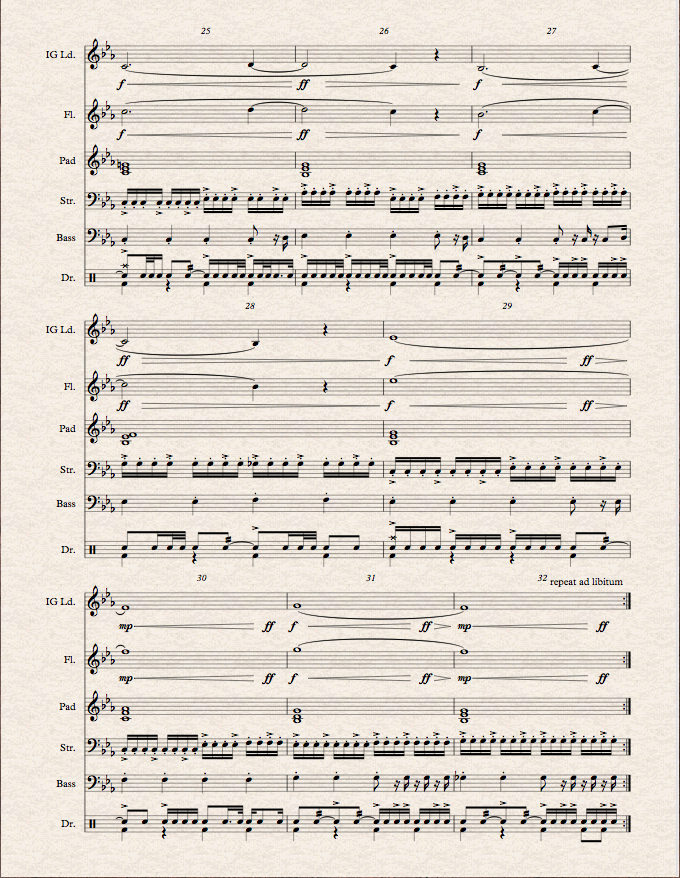
View full article »I just finished the music to a game called Quartermaster Quandary. The player keeps the supply lines open to multiple battlefronts and must sort out train destinations as the trains come into the yard. The final build isn’t out yet, so I set the music to this video.
Here is a sample of game score from the Quartermaster Quandary project. Select an image to open it full size in a new window.
I remember the first single I heard on the radio from Jagged Little Pill by Alanis Morissette. I remember asking myself, “What is that screeching sound?” as I listened to You Outta Know…but then I listened to the lyrics and could hear plain and simple emotion, expressed powerfully with no wrapper or gloss.
Revisiting the album now, I realize this woman’s work embodied the angst and general feeling of disillusion many people felt in the ‘90s and even now. When asked in a 1995 interview, “Was there always this…angry, naughty woman waiting to get out?” Alanis Morissette replied, “Oh…she was definitely always there. I just chose consciously not to show it because I don’t think I was prepared to…to be that naked, really.” (Alanis Morissette – The New Music Interview (1995), 2012) Alanis Morissette gave mutual feeling, unspoken security, and angst a voice in Jagged Little Pill.
My wife and I chose the house we live in due to its unusual character. It has had four additions since it was built in the ‘40s and each addition presented problems in which the solution made the house unique and unlike the cookie-cutters built in our old community around the ‘90s. It’s amusing to me that one of the strongest character traits of Jagged Little Pill is that it screamed out to the middle of the 1990s, “Don’t accept mediocrity and the five models offered in this new neighborhood of 150 houses.”
In addition to the signature angst of the album was the character trait of being imperfect and seeming unpolished, yet revealing highly sheened production on further inspection.
I believe Jagged Little Pill encouraged other artists and mainstream popular music of the time to reach a little deeper.
As a songwriter, Alanis Morissette and Glen Ballard teach me to pay attention to the whole package. Many seemingly unlikely stars from the past have succeeded with the same chemistry as Alanis Morissette, through emotional content and a genuine outlook that connects. Being technically proficient is important, but getting wrapped up in it and forgetting the other elements of music, such as emotional impact and spontaneity, which make the connection to others, can limit success. This is the lesson I will strive to apply to balance my own efforts in the future.
I have a television at the top of my keyboard workstation I use for a second monitor, so, as I write this article, and throughout every day in my studio; setting prominently in front of me is my Sequential Circuits Six-Trak.

I’ve spent many hours with this synthesizer over the years and have been in the guts of its programming. As an electronics technician, I’ve had it open and been in the circuitry. I must admit an overly emotional attachment to my Six-Trak. So, I’ve decided to look into Sequential Circuits and find out more about their story, specifically Dave Smith.
Dave Smith, in an interview with Ean Golden, said,
I think it’s really hard for a piece of software to have personality whereas an instrument… I mean, if you’re a guitar player, if you play any instrument…you have your axe and there’s a personality, and a link between you and the instrument.
(Golden, 2013)
Hearing this, I could immediately identify with Dave Smith and understood that the same attachment I feel for one of my favorite instruments is the same as the attachment he had for making it.
Much of the information found on Dave Smith is critical of Sequential Circuits’ production problems and the huge risks that eventually ended the company. In almost the same breath, the same articles speak of the genius and brilliant engineering of Sequential Circuits. (Reid, 1999) The truth in matters such as these generally lies between the most brutal and most forgiving opinions. David Smith is a brilliant engineer, but it seems he could have taken SCI much further had he surrounded himself with a bonafide businessman, publicist, and production/quality control specialist and then kept their advice.
Dave Smith is not afraid to take risks. His eventual loss of Sequential Circuits came from the risk of taking on home computer audio too early. Sequential Circuits did not have the capital to match their vision. Some say the risks Dave Smith took and the flaws he tolerated in the components of his synthesizers were the character trait that made his product so spectacular. We get the same heat standing by a fire or a radiator, but the fire is more genuine and has significantly different character.
Considering Dave Smith’s accomplishments, his contribution to the Musical Instrument Digital Interface (MIDI) standard alone make him a legend in the world of music. His company had a faster and more robust solution to communication between electronic instruments, but he put that aside in recognition of a higher cause.
Dave Smith was instrumental in making MIDI real. Without his adamant leadership all the companies involved, who were strict competitors, would not have come to the table and stayed. Dave Smith and Ikutaro Kakehashi (Roland) received a technical GRAMMY award in 2013 for their role in the development of the MIDI standard. I believe most modern musicians would agree; todays’ music would not be the same without MIDI.
As a listener I hear Dave Smith’s innovation every day in my favorite songs. The list of chart-busting songs using Sequential Circuits’ products is long. As an industry professional I recognize his contribution to the music industry every time I use a synthesizer, open a Digital Audio Workstation (DAW), or use any software related to the music industry.
Reference articles and videos: View full article »
Placing Kraftwerk neatly into a genre box is easy enough, but keeping them in said box…not so much. When pressed to define their music, we quickly find we should get a couple more boxes. Perhaps a geodesic dome would be more appropriate, given the compound facets on the surface of Kraftwerk.
The Kraftwerk product is clearly electronic music, but when accounting for when and how they were electronic musicians, a larger, and much more innovative and experimental story comes to light. Our two main culprits in the sum of Kraftwerk’s image and ingenuity, Ralf Hütter and Florian Schneider, are classically trained musicians who chose to express themselves in any way other than traditional methods.
Early Kraftwerk found synthesizer technology to be young and much of the commercial offering was still monstrous and highly technical, requiring skills approaching engineer caliber. Hütter and Schneider approached the technology with zeal and seemed to be at odds with the stereotypical musician of the time. Their enthusiasm for all sorts of electronic gadgetry and invention became part of their image. Amplifying their engineer image, they wore suits and maintained businesslike grooming standards during performance. This was also very much different from the ‘70s trend for musicians.
One of the defining characteristics of Kraftwerk was the air of “moving on” they projected to their countrymen. It seems post World-War II Germany was trying very hard not to look back and Kraftwerk gave its generation the message, “fine… look back, make your own interpretation; don’t look back, ignore the past; call it what is was or not, but let’s not wallow in it and then let’s move on.”
Another Kraftwerk characteristic to consider is the palette of timbre and technique they offered the world. They weren’t the first to work in electronic music, but they were certainly pioneers in application of its tools and methods. Consider the composition of the song Autobahn and then imagine the song performed on traditional instruments of the period rather than the electronic inventions of Moog, Arp, EMS, and Kraftwerk.
(The Balanescu Quartet – Autobahn, 1992)
Kraftwerk released the Autobahn album in 1974, which marked the beginning of their transition to more organized and less avant-garde or experimental music. (Kraftwerk, and the Electronic revolution, 2010) Kraftwerk music prior to Autobahn was less structured, lacking form and melody. There was still nobody in the main stream doing what Kraftwerk was with music in 1974. Listening to songs from the year-end top 100 for 1974, one can catch a hint of synthesizer here and there, but nothing on the scale of the electronics in Kraftwerk.
1975 brought the Radio Activity album in which Kraftwerk further cemented their transition to electronic pop music and left behind the purely experimental. They were still experimenting, but now had their own studio, called Kling Klang, where the final product of their experiments was more structured. The studio became the experiment as much as any specific device. Kraftwerk was now experimenting with the production process more than ever before.
Beginning with Autobahn (the road), then with Radio Activity (radio and nuclear technology), Kraftwerk established themes for their albums. Concept albums were the norm through the ‘80s with the train of Trans-Europe Express, the robots of The Man-Machine, and the subject-titled Computer World. During these albums the music became increasingly polished and structured, yet uniquely marked with the Kraftwerk signature sound, which still carried the leading edge of electronic music. By the time Computer World came around, Kraftwerk took the Kling Klang studio on the road with them and their innovations expanded to become sensory encompassing events with synchronized visual displays playing into the themes of each song. (Bussy, 2004)
As a listener, I cannot believe I did not discover Kraftwerk sooner in my life. I am completely enthralled with their music. When I hear certain passages, I immediately identify them with music from other artists, which came later, and the lightbulb clicks on. Most of everything I like about electronic music has roots in Kraftwerk.
As an industry professional, I want to take a cue for innovation and creativity from Kraftwerk.
Marvin Gaye’s music prior to What’s Going On seems best separated into the difference between wants and needs. Sometimes the two intersect, but it’s hard to tell by appearance where Marvin is doing his own thing or toeing the Motown line with a smile. By many accounts he wasn’t happy with the Motown formula (Edmonds, 2001) and was feeling stifled from his jazz preferences and affinity for Nat King Cole songs. Listening to Save the Children, Nat King Cole’s singing style comes through.
Renaldo “Obie” Benson of the Four Tops, aided by lyricist Al Cleveland began the original shape of what became What’s Going On in 1969. When the Four Tops shied from the song as a protest song, Benson began looking for another outlet. Benson presented the song to Gaye and they played it together. After Gaye made the song his own by adding lyrics, making minor changes to the melody, and turning it into a more visual story, Benson said, “We measured him for the suit and he tailored the hell out of it.” (Edmonds, 2001)
Marvin Gaye’s image changed dramatically during and after his production of What’s Going On. In video footage of his performance prior to What’s Going On he is seen in a suit, surrounded by neatly clad “go-go girls” while he croons about the pains and joys of love. (watchmojo, 2012)
Responding to the accounts he hears from his brother about the war in Viet Nam and the social upheaval of the late ‘60s, Gaye consciously begins to change his image.
To further disassociate himself from the tidy Motown niche labelled Marvin Gaye, the singer drastically altered his appearance. Like John Lennon and Jim Morrison, he grew a beard and dispensed with image-conscious fashion in favour of funkier attire. When people looked at Gaye, he wanted them to see someone they’d never seen before.
(Edmonds, 2001)
Whether directly or indirectly apparent (by listening without analyzing), much of the social turmoil made it into What’s Going On. Events such as the assassinations of Malcolm X, Martin Luther King, and Bobby Kennedy, race riots and police brutality in Watts, Detroit, Chicago, and at Kent State were all represented in some way.
It seems Marvin Gaye dragged Berry Gordy and Motown, kicking and screaming, out of the malt shop and into social awareness. It’s not that any person alive at the time couldn’t see the news of everything going on…perhaps they just needed to pull the flamingo’s head out of the Las Vegas sand.
Getting What’s Going On released faced obstacles, which took Marvin Gaye considerable time to overcome. So much time Marvin was able to beef himself up to 200 pounds in an attempt to join the Detroit Lions.
What’s Going On was completely and purposefully foreign to the Motown formula. It wasn’t just different; it flew in the face of Motown Quality Control. Berry Gordy didn’t like it. He reportedly called What’s Going On, “…the worst thing I’ve ever heard in my life.” (Edmonds, 2001)
Perhaps Gordy’s true feelings were influenced by personal feelings as much as professional opinion. Marvin Gaye was married to Berry Gordy’s sister and this sometimes slanted the professional relationship. Gordy’s business judgment must also have been screaming in his ear to keep his business as far from politically charged subjects as possible. The subject matter and lyrics of What’s Going On characteristically set it apart from the standard Motown repertoire.
Recording What’s Going On was complicated by its departure from the Motown formula. Because Marvin wanted it to be different he systematically worked on replacing each Motown style trait with something characteristically new.
Van DePitte says that Gaye wanted to stay away from anything resembling a standard Motown beat. The arranger brought in veteran big band drummer Chet Forest, augmented by a phalanx of percussionists: Jack Ashford on tambourine, Eddie Brown on bongos and congas, Earl Derouen on congas and Jack Brokensha on vibes and assorted percussive toys.
(Edmonds, 2001)
As a listener, I am always impressed when someone with the ability to influence others takes the time to craft a statement artfully. To question authority or the status quo in a manner that initiates awareness and makes a call to action is an art in itself. Doing so without telling others what we think they should do takes great forethought and restraint.
As an industry professional, I admire the full process Marvin Gaye went through in reaching the decision to see What’s Going On through to release. Not only did he have to change his place in the world by deciding to take on the banner of awareness, but he also had to risk his own career and living to hold out for something in which he believed.
It’s said life is not a destination, but a journey. Why do I raise such a worn-out saying? To illustrate how Brian Eno takes overused clichés, dismantles them and shows us the inside, then turns them on edge, peels the inside layer away and shows us the middle. The point I’m making here is: Brian Eno hasn’t considered the destination in decades. He’s moved beyond the journey, obsessed and consumed by the side roads, tangents, dead ends, and any other metaphor you can think of for the unexplored fringe. In an Alfred Dunhill interview Brian states, “The sense of; I really want to know how this turns out…will drive you on through many, many long nights of no results (knowingly laughs)…whereas the feeling of; I think I ought to do this…dries up very quickly.” (Alfred Dunhill, 2013) Brian Eno’s relentless pursuit of the next tangent is one of the defining characteristics setting his projects apart from all other works.
I think the next most defining characteristic for Brian Eno’s projects is his desire to find his own system for everything. He self-identifies as a “non-musician” and seems to have little use for centuries old systems of music theory and structured composition. (Tamm, 1988) It’s not that he doesn’t see a need for order and structure; he just doesn’t necessarily see the benefit in pigeonholing anything he does into a container that doesn’t fit.
Eno was always trying to unlock new modes of creativity. He recorded Another Green World using a deck of cards called Oblique Strategies. Each card had an aphorism on it, and when Eno reached a creative impasse, he would pull a random card from the deck and faithfully follow its instructions, even if it said, ‘emphasize flaws’ or ‘do nothing for as long as possible.
(Echoes, 2010)
Brian Eno’s earliest musical influences came from U.S. Air bases near his Suffolk England hometown of Woodbridge. Today we wouldn’t think anything of American music being heard in other parts of the world, but in the 1950’s, music didn’t travel as quickly and only the most popular music made the trip. Eno referred to Doo Wop as “Martian music” because it was alien to any English tradition and “…could have been from another galaxy”. (Tamm, 1988) Throughout his career, Brian Eno uses the idea of removing music from context to add mystery, surprise, and allure.
It’s hard to name singular influences on Brian Eno. He is credited for creating genres and his experience stretches across many art forms. In each of his ventures into yet another area of experimentation he gathers a new set of influences, mostly different from the last. The primary influences leading up to his ambient music were the minimalists, John Cage, La Monte Young, and Terry Riley. As a child, Eno’s parents had a player piano with hymns, which Eno says has given his music a persistent melancholy quality. Another subtle influence on the Music for Airports album and perhaps the Scape app for iPad as well was the Ray Conniff Singers he heard as a child in his uncle’s music collection.
The Music for Airports album has two threads of happenstance running through it, which I find interesting. The first thread leads to the album being a result of a series of accidents, literally starting with Brian Eno falling in front of a moving taxi. The other (less life threatening) part of this accident was Eno listening to harp music during recovery from the taxi accident and not having enough energy to get up and fix a speaker malfunction or raise the volume when he realized it was too low. Eno experienced his first natural ambient experience, somewhat involuntarily, compounded by his own exhaustion and a rainstorm. This experience changed his direction in music radically from the forefront to the background.
The second thread running through the Music for Airports album is Brian Eno’s search for a music system to generate music from a random seed or some method of self-generating endless song.
In a sense, the Scape app for iPad has been around since Brian Eno began to imagine a system of generative (or regenerative) music. He’d just been waiting for technology to catch up with his ideas or to give him a way to express them. Brian Eno said, “Creativity is a little bit like water; It sort of seeps out wherever there’s an outlet.” (BBC Newsnight, 2011)
Music for Airports, in comparison to the Scape app is both a precursor and a trial run. Brian Eno said,
When I was making music like Music for Airports, which came out at the end of the seventies, what I was really doing was setting up a system to produce music; and then recording a little bit of the music and releasing that recording. What I really was interested in was the system. I would really have loved to be able to release the system to people so that they can use it and it produces music, which doesn’t repeat.
(BBC, 2012)
The contrast between Music for Airports and Scape is clearly technological evolution. Eno said, “Sometimes you listen to things and you think, I’ve only really had one idea in my life… and I’ve just been doing it in a hundred different ways ever since.” (Alfred Dunhill, 2013)
I have a mixed impression of Brian Eno’s music as a listener. Innovation comes from experimentation and part of experimentation is coming to a bad end and then backing up and taking another route. I can appreciate the hard work, many hours, and sleepless nights resulting in the innovation, but I don’t necessarily want to hear each and every experiment leading to the breakthrough.
My professional impression of Brian Eno’s music tells me to be glad he has painstakingly documented his innovation for anyone to follow. His heart is a pie chart and there’s part scientist in there. Someday I will have some free time and I will be glad to deconstruct his methods, following the plethora of information he has openly shared as a pioneer.
What is it making the Beatles’ music so distinctive and worthy of emulation after nearly 50 years? I asked myself this question merely from the perspective of an assignment and realized I couldn’t answer it from the perspective of an assignment. Listening to and studying a particular music artist are two different things. I visited a website of Beatles fans (The Beatles Bible, 2013), and quickly became aware; a week of intense research and study would not do justice to true Beatles fans.
When I was young and first discovered vinyl LPs, Abbey Road was the record I pulled from the sleeve. When I became old enough to buy my own music, I owned the Red album and the Blue album. Looking at the discography of these two compilations (Discogs, 2013), one can see the line between Beatlemania and the Beatles cult drawn between Revolver and Sgt. Pepper’s Lonely Hearts Club Band. Although there were only two songs from Revolver in the entire content of both the red and blue collections (three if we include Paperback Writer from the recording session), this is where my experience draws the line also, including Revolver with the earlier collection.
The Beatles’ music before the Revolver album was, in many aspects, sticky sweet and seemingly meant for a juvenile audience. The Beatles’ image before the Revolver album was of a fun-loving, mischievous group of young boys. They were considered “clean cut” by most, though giving a slight hint of rebellion with the mop top haircuts, which were not the accepted style of the time (as though June Cleaver would say, “Oh, you boys” and young girls would automatically be drawn to the allure).
Revolver marked a graduation to a worldlier, somewhat jaded, dismissal of naiveté, at least in outward appearance. Many would argue the exact line of transition was not so clear and the Revolver album had some help at both ends from the Rubber Soul and Sgt. Peppers albums. Perhaps we could view Rubber Soul as leaning toward experimentation and Revolver as a purposeful transition into the unknown future of music.
The Beatles had many non-musical influences, marked not only by mutual experience, but also by distinct individual paths. George Martin and Geoff Emerick, both every bit as inventive as the Beatles themselves, influenced the Beatles in their mutual experience. Martin and Emerick created new methods of processing and presenting the music, some of which last to this day.
Hallucinogenic drugs and the religious practices of the world influenced the Beatles. John Lennon seemed to have a more distinct individual path with drugs and George Harrison with Indian religion. Paul McCartney dabbled or observed the other Beatles behavior in both drugs and world religion, but became more interested in technology as applied to music. (Newman, 2006) Ringo Starr doesn’t get much coverage for a distinct individual path of influence, but is whole-heartedly in the mutual experience of the Beatles. Could it be he was just busy drumming? It’s obvious he was paying attention to the other Beatles’ adventures when we hear evidence of Indian rhythms and experimental polyrhythms in the music.
The studio became an instrument to the Beatles. Tapes decks capable of slowing down, speeding up, and reversing their material became instruments. Tempo and key could be manipulated by tape speed. Normal material became otherworldly when played backwards.
The REX™ file (Propellerhead Software AB., 2013) and similar technology is the modern-day answer to one innovation used on the album Revolver. We are spoiled with the ability to “slice” any audio and process each individual slice any way we choose, including randomization. George Martin and Geoff Emerick had to record from vinyl to tape, analyze the tape for appropriate key and split points, cut the tape, and then to randomize, threw the chopped tape pieces in the air and physically spliced them back together. Did Martin and Emerick invent the hardware version of the REX file?
Another innovation used on the Revolver album is the bass guitar part, recorded using a matching loudspeaker placed directly in front of the amplifying bass loudspeaker as a microphone.
My impression of Revolver as a student is blurred by my own experience as a music listener. I don’t consider it the Beatles best work as a listener. Having done some research on the album and having gained some historical perspective on the Beatles, I can see the significance it holds as a turning point in both their lives and music. I was born the day Paperback Writer was released in the UK; so don’t have the same perspective as a person present for the Beatles happening. I’m curious to hear the opinion of a person from the millennial generation, performing this same research on Revolver, independently.
My professional impression of Revolver reflects a more proper awe in the accomplishments of the band and their supporting cast, especially given the technology of the period. Much of what the Beatles accomplished on Revolver has been used over and over and has also been built upon by many, hoping to replicate or achieve at least a small percentage of the same result.
The Beach Boys’ music prior to the Pet Sounds album was youthful and all about fun-in-the-sun. The formula contained girls, surfing, and cars. The Beach Boys had a reputation for fun and were not really expected to produce anything of substance. I offer this observation as an antithesis to a quote from David Howard, referring to the development of Brian Wilson’s songwriting and production abilities; “Wilson was clearly beginning to move away from simple teen-aged anthems towards something far more mature and emotionally complex” (Howard, 2004, p. 57).
I think the Beach Boys’ had a reputation for being innocent, naive or unaware as part of their image prior to Pet Sounds. Brian Wilson stated he wanted Pet Sounds to be, “…something more introspective” (Wilson, 2012).
Brian Wilson took a leadership role early in the Beach Boys’ career. He had a clear vision for the music and realized he would need to take control to bring his musical vision to fruition. Although his father was managing and always vying for control, Brian managed to pioneer production control at an unprecedented young age. Eventually he fired his father as manager also, taking control of many aspects of the Beach Boys’ management.
Brian Wilson was also clearly in charge of the creative branch of the Beach Boys franchise. Pet Sounds was completed with collaborator/ Lyricist Tony Asher (not a Beach Boy) while the Beach Boys, minus Brian, were touring. The rest of the Beach Boys were presented their parts for the entire Pet Sounds album on return from touring.
Brian Wilson’s first big influence toward music production came from a gift on his 16th birthday. He was given a reel-to-reel tape recorder and in his ensuing obsession with the recorder, “…Brian Wilson discovered his passion and realized it coincided with rare God-given talent” (Howard, 2004).
Brian Wilson was influenced by the Beatles in a sort of album-by-album friendly competition of one-upmanship. Perhaps when the Beatles started singing about more mature themes, about the time of their Rubber Soul and Revolver albums, Brian became a little more serious in the competition and this influenced his attitude toward the intellectual and emotional content of his songwriting.
He was also influenced by Phil Spector’s “wall of sound”, which he first heard in the song Be My Baby by the Ronettes. Brian Wilson put a lot of time into analyzing and emulating Phil Spector’s production techniques.
The amount and variety of instruments used in the Pet Sounds album gave it a unique quality. Brian Wilson used the “Wrecking Crew” responsible for Phil Spector’s “wall of sound” and there were generally many layers. The remastered versions of the Pet Sounds songs in stereo present the album in a whole new light. Hearing the backing vocal harmonies spread across the panorama spectrum is incredible, especially in Wouldn’t It Be Nice and Sloop John B. It’s amazing how many instruments are given a prominent part in stereo without detracting from the song. The low saxophone part in Sloop John B is hardly discernible in the mono mix. God Only Knows takes on a new life when the percussion, such as wood blocks, sleigh bells, and tambourine are given their own place in the panorama spectrum.
Another key characteristic of Pet Sounds is the appearance of a story line in an LP. Brian Wilson tells us in Pet Stories (Wilson, 2012), the album represents the journey through life and making an inspection or taking inventory.
My first impression of Pet Sounds as a listener is to be somewhat put off by it not sounding like the stereotypical Beach Boys music. When I take in the whole of it, considering the lyrics, it becomes more a work of art and seems more crafted than prior Beach Boys material.
My professional impression lends to dismantling Pet Sounds and seeing what makes it tick, and I know Brian Wilson would appreciate the sentiment.
This is a cover of Boat on the River by Styx, sung by my daughter, Haley. The MIDI class assignment was to download a MIDI file and remix it, adding two or three elements.
I am a Songwriter/Composer and this is one of my places to share ideas, inspiration, and critical review of music and audio works. I have a variety of tastes (as well as ability) in different music genres. I am interested in collaboration for the sake of art.
My primary focus now is on:

so…if you are looking for a conversation about songwriting, composition, production, or would like someone to collaborate with, please contact me.


 StullSounds